
Emotional wellbeing support for people and animals
Animals
As Dr Bradley Nelson explains, animals express emotions clearly even without words, and emotionally upsetting experiences may affect them deeply.
According to The Emotion Code®, animals, just like people, may experience trapped emotions connected to stressful or emotionally intense events. Within this method, trapped emotions are identified through a chart containing 60 specific emotion categories, such as Shock, Panic, Grief, Helplessness, Vulnerability, and others. These are not personal interpretations, but part of the structured Emotion Code system used during sessions.
Some people choose sessions to support their animals’ emotional wellbeing, behavioural challenges, stressful experiences, or periods of adjustment. Sessions are performed remotely, allowing animals to remain relaxed in the comfort of their familiar environment.
Please keep in mind that many behavioural issues may also be related to training, environment, health conditions, or other practical factors. The Emotion Code is not a replacement for proper veterinary care, professional behavioural support, or appropriate training.
Animals may also reflect emotional stress within their environment. For this reason, some owners choose to explore sessions for themselves as well.
After a session, some animals may appear calmer, sleepier, or more relaxed while processing the emotional release.
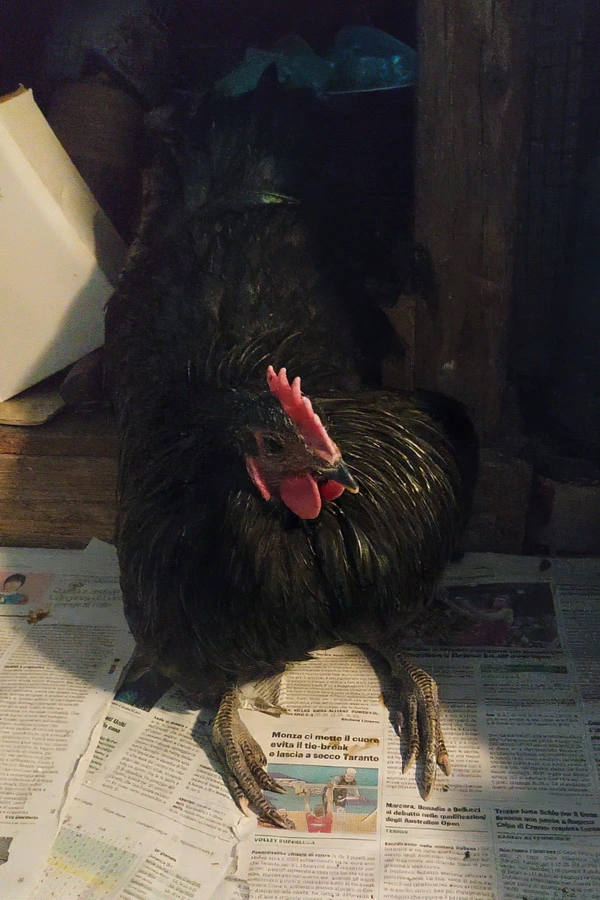
To help illustrate the emotional complexity animals may experience, I would like to share a very personal story about Amrok, a young rooster who accompanied me during an important period of my life.
Amrok was volunteering for me while I was in the process to become a Certified Emotion Code Practitioner. When Amrok died he was only six months old. He had Marek’s disease. After his death I was very close to quitting practising The Emotion Code, it was extremely tough for me to accept that the Universe had its own plan for Amrok very different from my own hope to help him live. It was extremely tough accepting that my capabilities are limited. Even though in one of the last sessions, Amrok made me understand that I did help him, I really don’t know how, since he died anyway.
Definitely Amrok has helped me! He helped me understand that I can only do my best in order to help someone, I can’t determine anybody’s life or death. He also helped me to discover the amazing animals’ world. They have such complex emotions that I could never have imagined.
Here are some of the trapped emotions identified during Amrok’s sessions:
- Shock at the age of 3 weeks (when he stumbled and had been limping ever since)
- Shock at the age of 2 months and 3 weeks (when he got stuck and could no longer free himself)
- Panic at the age of 4 months and 3 weeks (when he realised he would no longer be able to walk)
- Being unable to walk he felt: Frustration, Betrayal, Sorrow, Helplessness, Grief, Vulnerability, Panic, Indecisiveness, however he made me understand he wanted to live
- When he was taken to the vet and was left in the clinic alone he felt: Panic, Shock, Discouragement, Vulnerability, Sadness, Hatred, Longing, Heartache, Taken for granted, Helplessness
- Next day: Lack of control, Depression, Love unreceived, Worthless, Frustration, Unsupported, Creative insecurity
It was Amrok who made me understand that I have to continue practising The Emotion Code to help others.
Finally, I am sharing Amrok’s story to invite people to pay close attention to every creature in the world and to treat animals with kindness and respect.
Animals are deeply sensitive beings, and their emotional world is far more complex than we imagine. I hope Amrok’s story may encourage greater understanding and gentleness toward every living being.
Testimonials

I have been suffering from insomnia for many years. After two sessions the result is positive. I am grateful to Marina, thank you very much. My insomnia has stopped bothering me. I recommend it, it does help a lot. My wife Svetlana was bothered by stomach pains. She could not understand whether it was gallbladder, or pancreas, or intestines, she was nauseated, could not go without medication even for a day. After the first session she felt much better and after the second session she forgot about the pills and felt fit as a fiddle. She has no problems now and is very grateful to Marina, God bless her for many years to come!!!
Alexander K., Poland
Marina has been caring and thorough in helping me unravel certain emotions that have been in my family for some time and for that I am thankful. It feels like I can walk a little lighter on my feet. At first I did not know what to expect but she helped me release hidden emotions which I was unconsciously carrying.
What was amazing is she did this over mails and messages and different time zones as we live in different countries!
Anita G., India
After a difficult divorce, I was diagnosed with PTSD. The prescribed treatment did not help, so instead of taking the prescribed medications, I decided to try The Emotion Code. After three phone sessions with Marina, my symptoms decreased noticeably and I became calmer. She gave a heart-wall session to my nine year old son as well. I was very worried about his despondency. After that, he became a cheerful, positive child. She worked with him by e-mail. Very convenient, as it did not take up my time at all. All this time, Marina was in touch, was interested in knowing the changes, and modified her approach when needed. She works for results! Many thanks to Marina for her help!
Olga K., Egypt
I’m a member of an association dedicated to the rescue and rehabilitation of rabbits. The purpose of the Association is to look after them and prepare them to be adopted by new families.
We often get special cases of rabbits with characters that are not exactly easy. I asked Marina for help with little Lulina, a very fearful one-kilogram rabbit. The little one could not cope emotionally with changes. The first time I brought her home, she immediately got encephalitis from the stress of change. Marina did some sessions for her by e-mail and I must say that I really got great results.
I was afraid to have Lulina change the room where she had been staying for a year for fear that her illness might return. Instead, after Marina’s sessions, she willingly accepted the change. In fact, she is much more active and curious.
I am really happy. I can say that Marina has certainly helped Lulina in making her ready for her new family.
Rachele C., Italy
I have been suffering from panic attacks for 15 years. Marina accurately indicated the year when they had begun. After just one session, they were gone. During the second session, we worked on my fear during driving lessons. Fear has been greatly reduced.
Anastasia S., Russia
The problem my horse had was a limp in the left front leg when he was under strain and loss of appetite, probably due to leg pain, resulting in weight loss. Traditional treatments hadn’t helped so I tried the Emotion Code sessions via email and I’m very satisfied with the result. Now he eats all the hay I prepare and I notice he is more active. For now, during and after the stud activity, he no longer has any leg problems. Thank you Marina.
Enrico T., Italy
I asked Marina to remove my heart-wall. It took seven sessions. After the second session the pain in the right forearm, which had been bothering me for six months, was gone. Without the heart-wall, I feel lighter and the tension and insecurities have disappeared. Thank you for your help.
Natalia P., Russia
I asked Marina for help with one of the bunnies I was fostering, the beautiful Dodo, a little one who was clearly displaying behaviour linked to past trauma and abuse. Marina did remote sessions, which gradually let to improvements. Shortly after, Dodo found a wonderful adoption. During the journey, Dodo was trembling like a leaf, but after Marina stepped in with another session, he calmed down significantly, relaxed, started eating, and even upon arrival at his new home, he immediately began to explore curiously without showing any signs of fear.
Marina also conducted a session with me to help me cope with the separation from Dodo, who had been with me for over three years, and she was incredibly helpful.
At first, I was a bit sceptical, but my experience with Dodo and with myself proved how Marina can tap into emotions trapped even many years ago, and by working on them, positive results can be achieved.
Angela B., Italy